Season 1, Episode 1 Details:
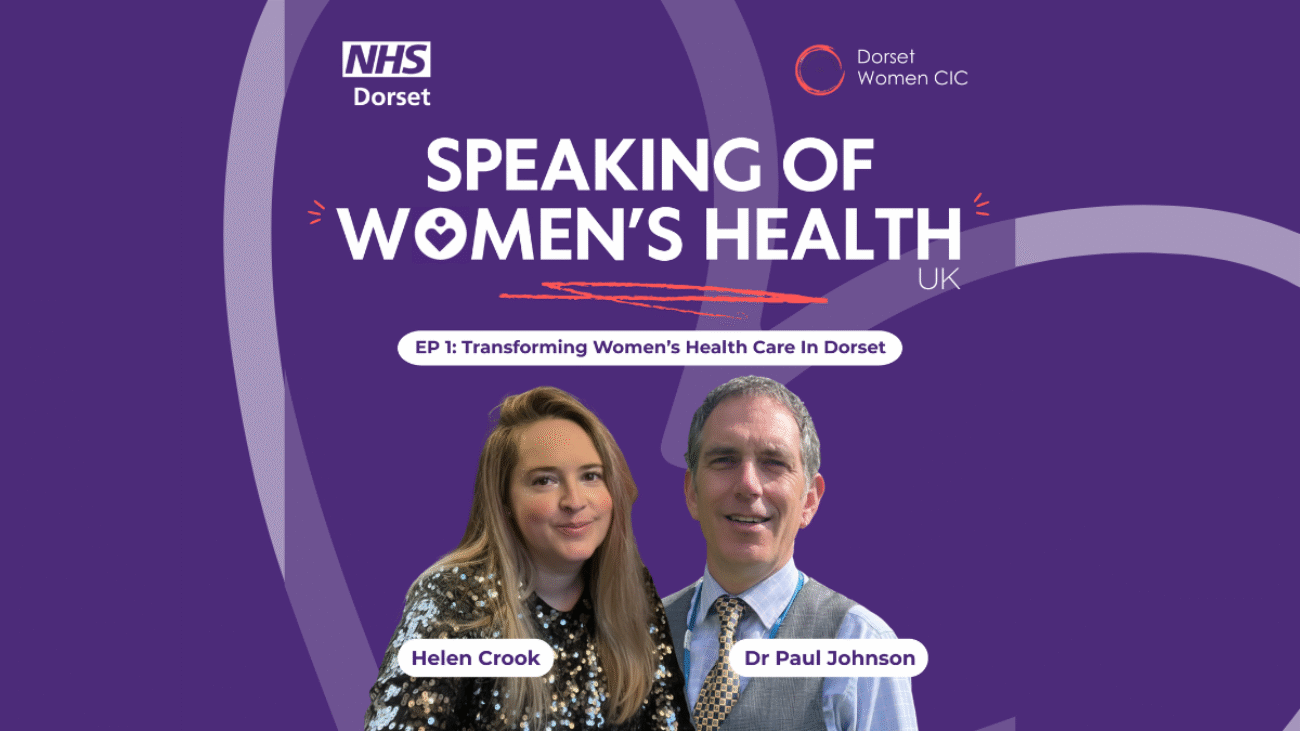
‘Transforming Women’s Healthcare’ with NHS Dorset’s CMO, Paul Johnson and Programme Manager, Helen Crook.
Episode Overview:
In this episode of “Speaking of Women’s Health UK”, NHS Dorset’s Chief Medical Officer Paul Johnson and Programme Manager Helen Crook discuss a groundbreaking women’s health programme designed to improve healthcare services in Dorset.
Detailed Episode Show Notes:
“We are doing this because we genuinely believe that women and girls in Dorset deserve better, and when we come back to that key objective there’s nothing that we can’t get through.”
How do we put women’s voices and experiences at the heart of systematic change? That was the challenge for NHS Dorset and Dorset Women CIC – two organisations who collaborated to address local challenges in women’s healthcare.
In this episode of “Speaking of Women’s Health…” our hosts, Marianne and Anjali welcome NHS Dorset’s Chief Medical Officer, Paul Johnson and Programme Manager, Helen Crook. Their candid discussion reveals the challenges and breakthroughs of their latest project, whilst offering a refreshing and hopeful perspective on the future of healthcare.
Whether you’re a healthcare professional, a woman navigating complex health systems or simply curious about how meaningful change happens, this episode offers a comprehensive understanding of the strategic efforts to enhance women’s health services.
👤Guest Profiles:
Dr Paul Johnson –
- Chief Medical Officer
- NHS Dorset
Helen Crook –
- Programme Manager
- Transformation Delivery
- NHS Dorset –
⏱️ Chapters:
[0:00] Podcast introduction & project overview
[6:12] Guest introductions & professional backgrounds
[10:06] Project motivation & initial challenges
[25:39] Engagement & community involvement
[36:15] Programme achievements & systemic impact
[45:52] Cultural considerations & future sustainability
🔑Key Themes:
- Empowerment through information
- Collaborative healthcare design
- Creating systematic change in women’s health
- Cultural competence and inclusivity
- Continuous improvement and advocacy
📖 Resources Mentioned:
- Women’s Health Support in Dorset: https://ourdorset.org.uk/women/
🔗 Connect with us:
- Dr Emma Hayward, LinkedIn: https://www.linkedin.com/in/dremmathurston/
- Marianne Storey, LinkedIn: https://www.linkedin.com/in/marianne-storey-46938435/
- Anjali Mavi, LinkedIn: https://www.linkedin.com/in/anjali-mavi-66a5a86/
- Dorset Women CIC Website: https://dorsetwomen.org.uk/
- Women’s Health Support in Dorset: https://ourdorset.org.uk/women/
🎯 Action Items for Listeners:
- Visit the Our Dorset Women’s Health website for evidence-based health information.
- Share the podcast and website with other women in the community.
- Consider how to advocate for women’s health in your local area.
- Encourage male family members and partners to learn about women’s health issues.
💡 Top Quotes:
2:00 – Marianne Storey:
“Sometimes we talk very negatively about women’s health and the NHS. Everyone has a story about difficult experiences. But the point of this podcast is for Dorset Women to understand that there is a lot going on to try and improve that on their behalf.”
2:30 – Marianne Storey:
“Dorset Women have been campaigning for over three years for this programme with the NHS. We went to the people at the top and we wouldn’t let it lie. And NHS Dorset came to the table, they listened to us and we created such a successful programme of collaboration between women and very senior people in the NHS.”
4:08 – Marianne Storey:
“I think it’s important that you hear from the people actually working in the hospitals, in commissioning departments, in public health, what they’ve been trying to achieve. It’s only been an 18 month programme, right? And as I say, things take a long time to change in the NHS. So let’s see what they have to say.”
4:35 – Marianne Storey:
“I would say that it has really started something that was very, very long overdue. It’s brought people together. It’s got people working together. It’s got people prioritising women’s health in a way that just hasn’t been done for decades. And it’s started to, I would say, hold the NHS to account for some of these problems that women have been experiencing. For me, that’s the biggest thing it’s done, it’s really got the ball rolling.”
16:19 – Helen Crook:
“We partnered with Dorset Women so we could make sure that every decision we made throughout this programme was co-produced with those that are on the receiving end. What does our community of women and girls feel would be useful for them?”
18:06 – Helen Crook:
“Yes, this programme is very much about women and girls, but it’s also about the partners of women and girls. It’s about the family members. We need to bring males along with us.”
21:51 – Paul Johnson:
“The clinician-patient relationship has shifted and the power base now sits with the patient. One of my hopes is that we would shift the power around controlling and making decisions about one’s own health and allow you to help yourself and choose when it’s appropriate to get expert help, and be involved in shared decision making around it.”
24:32 – Paul Johnson:
“I could come up with something that I think is great because the Consultant Gynaecologists or Consultant of Public Health tell me that’s the best thing to do. But we could miss the mark and not manage the things that actually the women in Dorset are really concerned about. It was a nervousness handing over to Dorset Women but it was absolutely the right thing to do.”
32:00 – Helen Crook:
“We are doing this because we genuinely believe that women and girls in Dorset deserve better, and when we come back to that key objective there’s nothing that we can’t get through.”
34:02 – Paul Johnson:
“I remember as a GP, the menopause was seen with a degree of simplicity from a clinical perspective. There were one or two treatments you may or may not offer, and there were some narrow criteria as to why you would do that. I think the understanding of menopause has shifted hugely over that time, but many of my peers have not been able to keep up with that shift.”
39:40 – Helen Crook:
“I feel so proud of what we’ve managed to achieve together. I think the programme has been a real vehicle to get women’s health really high up on the agenda in Dorset, regionally and nationally.”
49:28 – Helen Crook:
“If we make the change now, women will be better off in the future, and it will actually be better for the healthcare system as well. Keep investing in women’s health both emotionally, financially, and keep it high on the agenda.”
 Transcript: Find the full transcript here. Please note, these notes are AI generated.